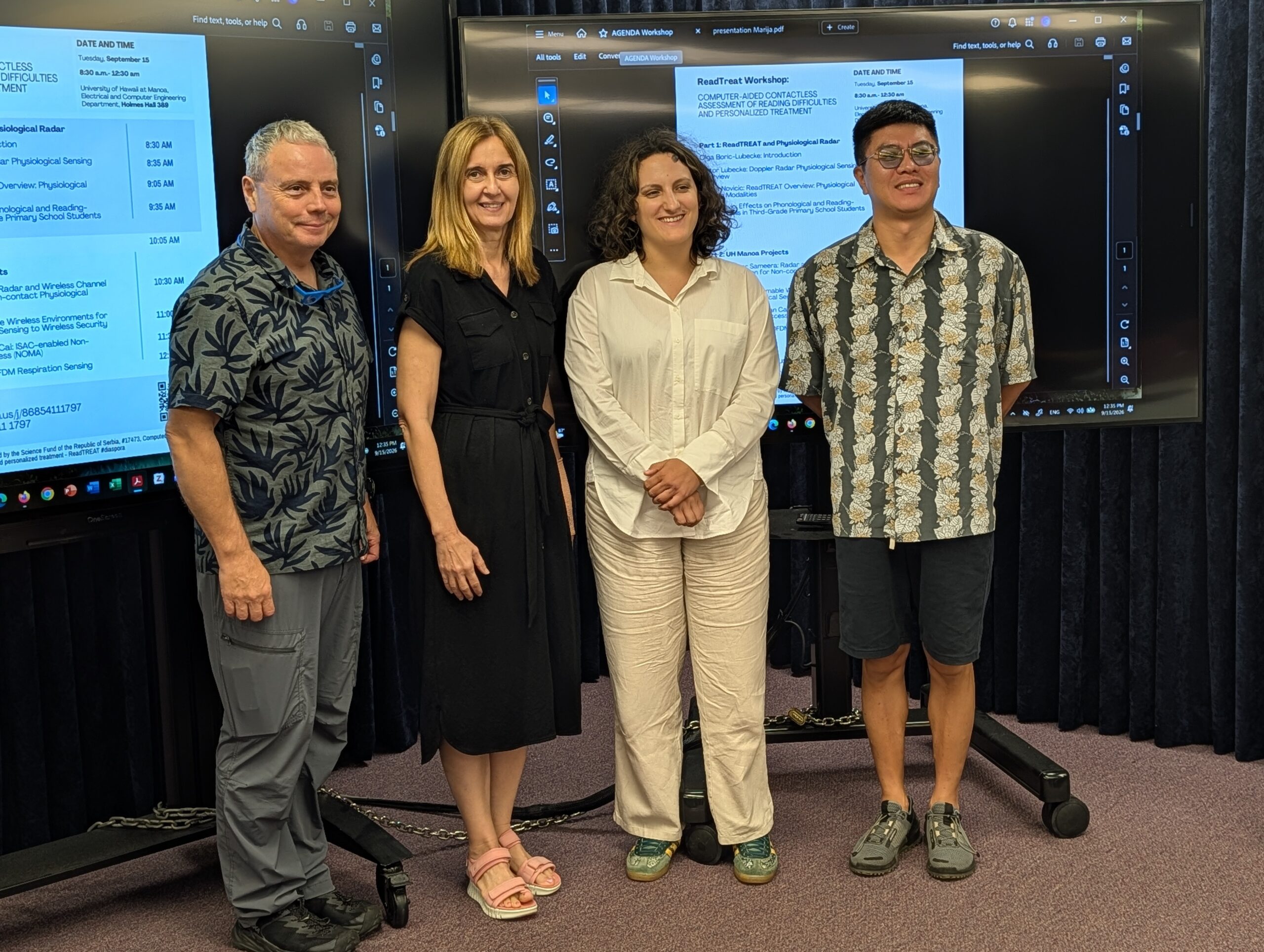
A scientific workshop exploring innovative, non-invasive approaches to assessing reading and phonological skills through Doppler radar and wireless physiological sensing was held on Tuesday, September 15, 2026, at the University of Hawaiʻi at Mānoa.
Titled “Computer-Aided Contactless Assessment of Reading Difficulties and Personalized Treatment,” the workshop brought together the Serbian ReadTREAT team, colleagues from the diaspora, and researchers from the University of Hawaiʻi at Mānoa working in radar sensing, wireless communications, and psychology.
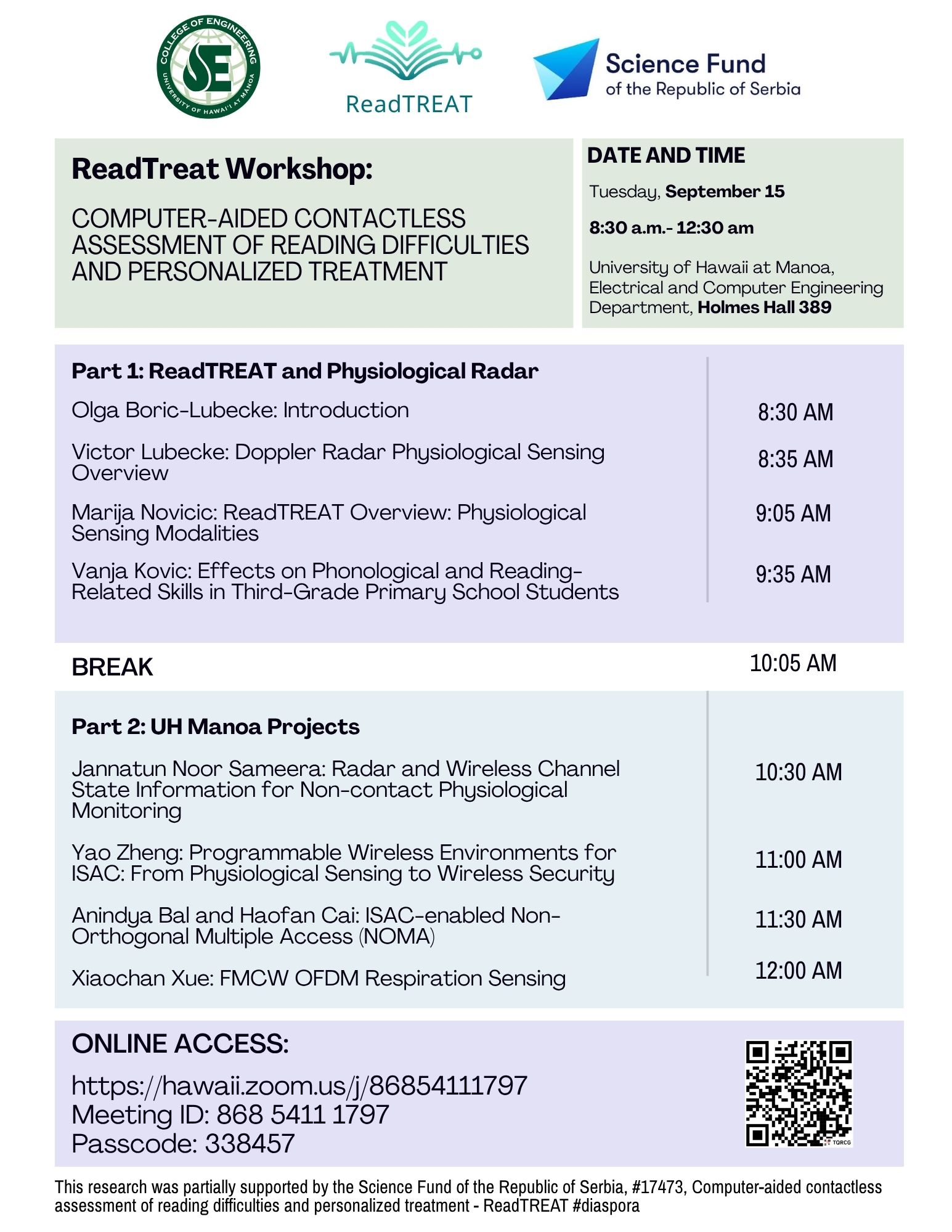
The first session focused on the ReadTREAT project and the use of Doppler radar to monitor physiological signals. Olga Borić-Lubecke opened the workshop, followed by Victor Lubecke, who provided an overview of Doppler radar physiological sensing. Marija Novičić presented the ReadTREAT project and the physiological sensing modalities explored within it, while Vanja Ković discussed the effects of treatment on phonological and reading skills in third-grade primary school students.
The second session showcased research at the University of Hawaiʻi at Mānoa. Jannatun Noor Sameera presented “Radar and Wireless Channel State Information for Non-contact Physiological Monitoring,” followed by Yao Zheng with “Programmable Wireless Environments for ISAC: From Physiological Sensing to Wireless Security.” Anindya Bal and Haofan Cai presented “ISAC-enabled Non-Orthogonal Multiple Access (NOMA),” while Xiaochan Xue concluded the session with “FMCW OFDM Respiration Sensing.”
Full agenda is available here.
The workshop provided an opportunity to exchange research findings, discuss the potential of contactless physiological monitoring for assessing reading difficulties, and explore future collaboration. It also strengthened cooperation between the Serbian project team, diaspora partners, and researchers in the United States.